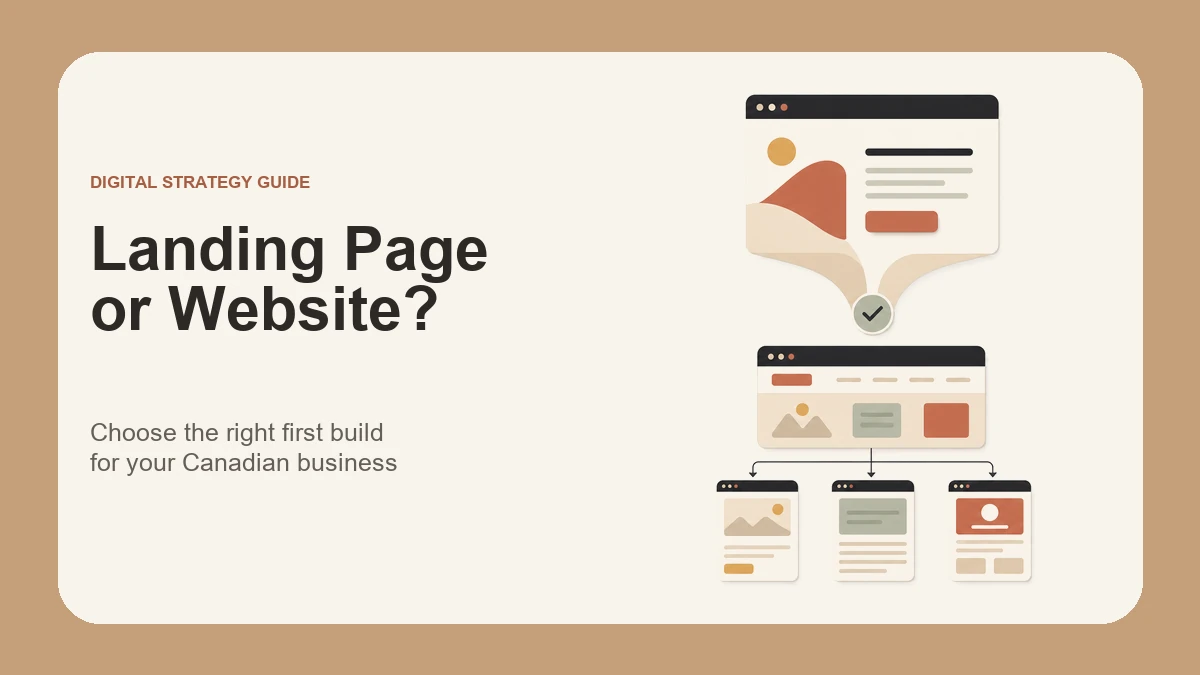
A landing page and a business website can both introduce an offer, build trust, and generate enquiries. They are not interchangeable, though. A landing page is usually designed around one audience, one source of traffic, and one primary action. A website supports a broader set of visitors, questions, services, and long-term business needs.
For a Canadian small business deciding what to build first, the right choice depends less on page count than on the job the digital experience must perform. A focused campaign may need a landing page. A growing company that must be discoverable, explain several services, and establish credibility usually needs a complete website. Some businesses need both, but they do not need to launch both at the same time.
This guide compares the two options so you can choose a practical first build without paying for pages that have no clear purpose or forcing one page to do too many jobs.
What is a landing page?
A landing page is a focused destination created for a specific visitor and outcome. Someone may reach it from a search ad, social campaign, email, referral partnership, event QR code, or targeted sales message. The page removes unnecessary choices and guides that visitor toward one main action, such as requesting a quote, booking a consultation, downloading a resource, or registering for an event.
Google Ads describes a landing page as the page people reach after clicking an ad and provides reporting to help advertisers assess how those pages perform. Its guidance also emphasizes mobile usability and speed because the experience after the click influences whether campaign traffic can act. The official Google Ads landing-page performance guide is useful when paid traffic is part of the plan.
A strong landing page normally includes:
- A clear promise that matches the traffic source.
- Concise supporting details for one offer.
- Relevant proof, such as testimonials, results, credentials, or process clarity.
- One primary call to action repeated at sensible points.
- A short form or direct booking path.
- Answers to the objections most likely to stop that specific visitor.
- Analytics for the campaign and its conversion action.
Focus does not mean thin content. The page still needs enough information to support an informed decision. It simply avoids unrelated navigation and competing offers.
What is a business website?
A business website is a broader digital home for the organization. It serves people who may arrive with different levels of awareness and different questions. One visitor may want to understand the company. Another may compare services, check experience, find contact details, read an article, evaluate a career opportunity, or return for support information.
A typical small-business website may include a home page, service pages, an about or proof page, contact information, privacy information, and helpful resources. The exact structure should reflect the business rather than a generic page-count package.
Google’s SEO Starter Guide recommends organizing a site logically, using descriptive URLs, and giving pages clear, useful titles. A multi-page website creates room to apply that structure to distinct services and topics. It also supports internal links that help people and search engines move between related information.
A website is usually the stronger foundation when the business needs to explain several offers, earn trust from visitors who are not campaign-ready, or build an ongoing search and content presence.
The practical difference: one journey or many
The clearest decision rule is simple:
- Choose a landing page when one defined audience should take one defined action.
- Choose a website when several audiences need to explore several questions or services.
That distinction affects almost every planning decision.
Goal and message
A landing page should make one offer easy to understand and act on. Its headline, proof, content order, and call to action all support that offer.
A website communicates the wider business proposition. Each page can address a different intent while the navigation and brand system connect the experience.
Traffic source
Landing pages work best when you know how visitors will arrive. A campaign message and its destination can be aligned closely. If an ad promotes emergency repair, for example, the page should not open with a general history of the company.
Website traffic is more varied. Visitors may arrive through branded search, a service query, a referral, a directory, social media, or a direct visit. The structure must help each person find the next relevant step.
Search visibility
A single landing page can be indexed and may rank when it provides useful, distinctive information, but it is not automatically an SEO strategy. One page has limited room to cover separate services and search intents without becoming unfocused.
A website can assign clear purposes to different pages and connect them through navigation and internal links. Google notes in its sitemap and discovery documentation that properly linked pages can generally be discovered through the site’s links; a sitemap is an additional discovery signal, not a substitute for structure.
Trust and depth
A landing page can build strong confidence for a narrow offer by showing targeted proof and answering specific objections. However, some visitors will still look for broader company information before they enquire.
A website provides more room for service detail, process explanations, experience, policies, team information, case studies, and educational content. That depth is especially useful when the purchase is considered, customized, or high-value.
Measurement
A landing page has a clean measurement model: traffic enters, visitors engage, and a defined action either occurs or does not. That makes campaign testing easier.
A website supports several meaningful actions. Enquiries, calls, bookings, downloads, article engagement, and service-page visits may all matter. Measurement needs a clear plan so the business does not confuse activity with results.
Maintenance and growth
A landing page is smaller, but it is not maintenance-free. Forms, analytics, consent tools, software, mobile layouts, and campaign claims still need review.
A website creates more content and technical responsibilities, yet it also gives the business a reusable platform. New services, case studies, location information, and resources can be added without rebuilding the entire experience.
Choose a landing page first when the offer is already clear
A landing-page-first approach is sensible when:
- You are launching one campaign with a defined traffic source.
- The offer, audience, and call to action are already validated.
- You need a focused destination for an event, webinar, lead magnet, or promotion.
- A sales team needs one link tailored to a particular service or market.
- You already have a credible website, but a campaign needs a more direct path.
- You want to test positioning before expanding into a larger content structure.
Before building, be specific about what happens after the conversion. Who responds to the enquiry? How quickly? What information does the team need? A polished page cannot fix an unclear offer or an unowned follow-up process.
Nexxen Studio’s guide to landing-page design and conversion support explains how message continuity, proof, mobile usability, and clear actions work together without relying on manipulative tactics.
Choose a website first when credibility and discovery matter
A website-first approach is usually better when:
- The company offers multiple services or serves several customer groups.
- Prospects routinely research the business before making contact.
- Organic search and educational content are part of the growth plan.
- Partners, job candidates, existing customers, and prospects all use the site.
- The current online presence does not clearly establish ownership, process, or trust.
- The business expects to add services, locations, resources, or case studies.
The first version does not need to be large. A thoughtful small website can be more useful than a sprawling collection of repetitive pages. Start with the information visitors genuinely need and give every page a distinct purpose.
If an existing site is confusing, slow, inconsistent, or difficult to edit, review the small-business website redesign guide before deciding whether to add a landing page on top of the current foundation.
When a business needs both
For many established businesses, the best system is a website as the durable foundation plus landing pages for focused campaigns.
The website explains the company, services, expertise, and broader proof. Campaign landing pages then speak directly to defined audiences without forcing every visitor through the same general journey. Shared brand styles, analytics standards, form handling, and reusable components can keep the system consistent.
This does not mean duplicating website copy onto a new page. A campaign page should reflect the promise that brought the visitor there, while linking to broader company information only when it helps the decision.
A common sequence is:
- Build a credible, maintainable core website.
- Confirm analytics, forms, and follow-up ownership.
- Launch one focused landing page for a measurable campaign.
- Review traffic quality, user behaviour, and lead outcomes.
- Improve the offer and page using evidence rather than cosmetic preference.
Performance should be checked before paid traffic scales. The WordPress speed optimization guide outlines a diagnostic process for images, scripts, caching, hosting, and mobile experience.
Scope the minimum viable version
For a landing page, the minimum viable scope usually includes one clear promise, relevant supporting detail, proof, a primary action, mobile-responsive design, a functional form or booking path, privacy considerations, and analytics. Add sections only when they answer a real visitor question.
For a small website, the minimum viable scope often includes:
- A home page that explains the business and directs visitors appropriately.
- Dedicated service information rather than one vague list.
- An about or proof section that supports credibility.
- A clear contact path and ownership of incoming enquiries.
- Privacy and other required business information.
- Basic search, accessibility, performance, security, and analytics setup.
- An editing structure the team can maintain.
The right scope is not the fewest possible pages. It is the smallest structure that fully supports the intended decisions and can grow without creating immediate rework.
Use six questions to make the decision
Before requesting proposals or choosing a template, answer these questions:
- What exact action should the primary visitor take?
- Do visitors need to understand one offer or several services?
- Where will traffic come from during the first six months?
- What proof is available now, and where should it appear?
- Is long-term search discovery part of the plan?
- Who will maintain content, forms, analytics, and follow-up after launch?
If the answers describe one controlled campaign, begin with a landing page. If they describe a business platform serving several needs, begin with a website. If both are true, establish the website foundation and prioritize the first campaign page based on a measurable business goal.
Build the format that supports the business
The choice between a landing page and a website is not a choice between “simple” and “professional.” Both can be well designed, accessible, fast, and credible. The difference is strategic focus.
Nexxen Studio’s web design and development services help Canadian businesses plan a useful scope, build a maintainable WordPress foundation, and create focused campaign experiences when they are justified. If you want help deciding which format should come first, contact Nexxen Studio for a planning conversation.